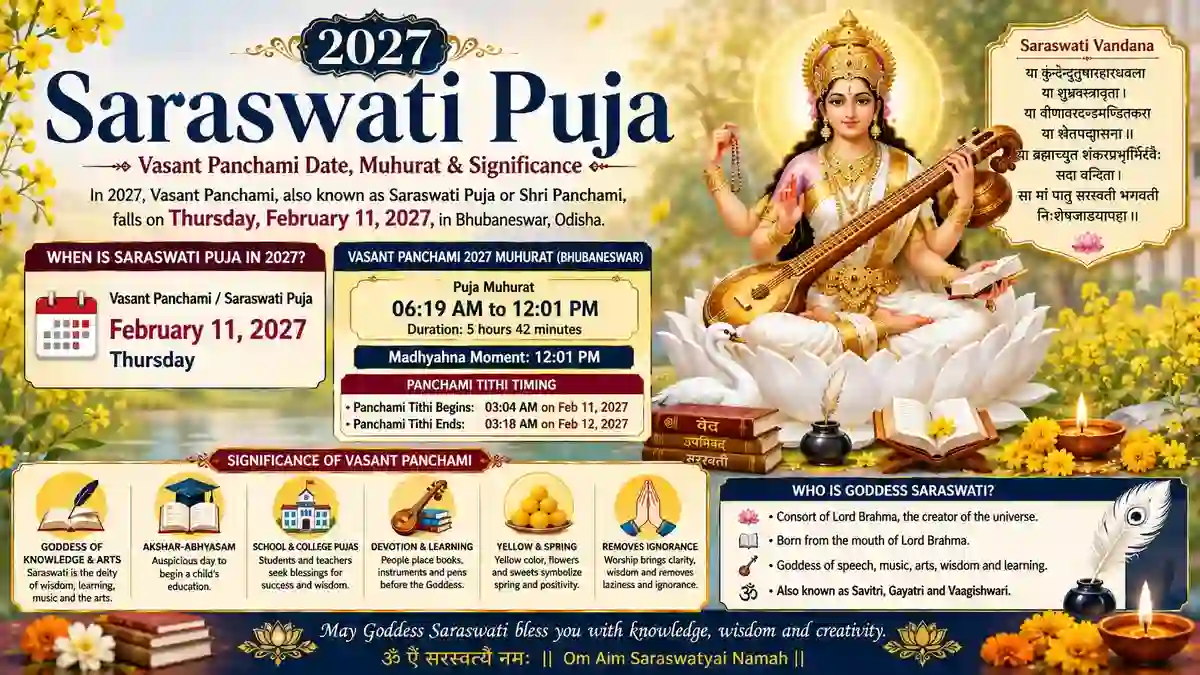
There’s something quietly beautiful about the way Vasant Panchami arrives each year right at the edge of winter, when the first hints of spring begin to show in the air, in the mustard fields turning yellow, and in the soft warmth returning to the mornings. It’s on this day that homes, schools, and colleges across India pause to honor Goddess Saraswati, the deity of knowledge, music, wisdom and the arts.
In 2027, Vasant Panchami, also known as Saraswati Puja or Shri Panchami, falls on Thursday, February 11, 2027, in Bhubaneswar, Odisha. This guide covers the exact date and muhurat, the story of Goddess Saraswati, the traditions associated with the day, and the sacred verses recited during her worship.
When is Saraswati Puja / Vasant Panchami in 2027?
Vasant Panchami 2027 falls on Thursday, February 11, in Bhubaneswar, India.
| Event | Date | Day |
|---|---|---|
| Vasant Panchami / Saraswati Puja | February 11, 2027 | Thursday |
Vasant Panchami is celebrated on the fifth day (Panchami) of Shukla Paksha in the Hindu month of Magha, marking the arrival of spring hence the name, where “Vasant” means spring.
Vasant Panchami 2027 Muhurat for Bhubaneswar
Getting the timing right matters, since Saraswati Puja should ideally be performed while the correct tithi is prevailing. Here are the exact timings calculated for Bhubaneswar:
Vasant Panchami Muhurat: 06:19 AM to 12:01 PM Duration: 5 hours 42 minutes
Vasant Panchami Madhyahna Moment: 12:01 PM
Panchami Tithi Timing
- Panchami Tithi begins: 03:04 AM on February 11, 2027
- Panchami Tithi ends: 03:18 AM on February 12, 2027
Why the Muhurat Falls in the Morning
Unlike many festivals that are tied to a single precise moment, Vasant Panchami is decided based on Purvahna Kala — the period between sunrise and midday. The day is celebrated whenever the Panchami Tithi prevails during this Purvahna window. Because of this rule, Vasant Panchami can occasionally fall even when a bit of Chaturthi Tithi is still lingering at sunrise, since it’s the Purvahna overlap with Panchami that ultimately decides the date.
In 2027, since the Panchami Tithi begins at 03:04 AM and comfortably spans the entire Purvahna period, the recommended puja window runs from sunrise (06:19 AM) all the way to Madhyahna (12:01 PM) — a generous 5 hour 42 minute stretch, giving families, schools and offices plenty of flexibility to perform the puja at a convenient hour within that morning.
Is There a Single “Best” Time?
Interestingly, many astrologers regard Vasant Panchami as an Abujha (अबूझ) day — meaning it is considered auspicious throughout, without needing a specific muhurat to begin good work. According to this belief, the entire day is favorable for performing Saraswati Puja. That said, the recommended approach is still to ensure the puja is done while Panchami Tithi is prevailing, and specifically within the Purvahna Kala window given above, since this is also when most schools, colleges, and families across India traditionally hold their Saraswati Puja.
Who is Goddess Saraswati?
Saraswati is the Hindu Goddess of knowledge, music, arts, wisdom, and learning. She holds a central place in Hindu tradition as part of a divine trinity alongside Goddess Lakshmi and Goddess Parvati — a trinity that assists Brahma, Vishnu, and Mahesh (Shiva) in their respective cosmic roles of creation, preservation, and destruction (regeneration) of the universe.
According to the Devi Bhagwat, Goddess Saraswati is the consort of Lord Brahma, the creator of the universe, and she resides in Brahmapura, his celestial abode.
The Story of Saraswati’s Origin
Goddess Saraswati is said to have been born directly from the mouth of Lord Brahma, which is why she became associated with speech, music, and knowledge from the very moment of her creation. Because Brahma created her, she is also referred to as his daughter in some texts — yet, according to many religious scriptures, Brahma was so captivated by her beauty that he desired to marry her, and she is widely honored as his consort. As her husband, Lord Brahma is also known by the name Vaagish, meaning “Lord of Speech and Sound.”
Goddess Saraswati is also known by other names, including Goddess Savitri and Goddess Gayatri.
How Goddess Saraswati is Depicted
Saraswati’s iconography is among the most serene and recognizable in Hindu tradition. She is typically shown as:
- A beautiful woman dressed in pure white, symbolizing purity and clarity of knowledge
- Seated upon a blossomed white lotus
- Playing a Veena, representing the harmony of art and intellect
- Accompanied by a swan and sometimes a peacock — in many depictions, she is shown mounted on the swan itself
She is portrayed with four hands, each holding something symbolic: a rosary (representing spiritual knowledge and the cycle of learning), a book (representing scriptures and formal knowledge), while her remaining two hands play the Veena, representing music and the arts. Together, this imagery reflects her domain over both intellectual and creative pursuits.
Why Vasant Panchami is Celebrated
Vasant Panchami is dedicated entirely to the worship of Goddess Saraswati, and the day carries deep meaning for students, artists, musicians, and anyone seeking clarity of mind. People worship her specifically to gain enlightenment through knowledge and to rid themselves of lethargy, sluggishness, and ignorance — qualities that stand in direct opposition to what she represents.
One of the most cherished rituals of the day is Akshar-Abhyasam, also known as Vidya-Arambham or Praasana — the ceremonial initiation of a child’s education. Many families choose this auspicious day to introduce their young children to their first letters or first lessons, believing that beginning education under Saraswati’s blessing sets a child on a path of wisdom and success.
Schools and colleges across India also arrange morning pujas on this day, gathering students and teachers together to seek the Goddess’s blessings for the academic year ahead.
Days Dedicated to Goddess Saraswati
While Vasant Panchami is her most prominent day of worship, Goddess Saraswati is honored on a few other significant occasions throughout the year as well:
- Vasant Panchami / Shri Panchami — her primary and most widely celebrated day of worship
- Navratri Saraswati Puja — observed during the nine-day Navratri festival, when she is worshipped alongside Durga and Lakshmi
- Diwali Sharda Puja — observed by certain communities during the Diwali festivities, particularly among Gujarati households, where new account books are blessed under her name as “Sharda”
Saraswati Vandana: The Sacred Verses
During Saraswati Puja, devotees recite the Saraswati Vandana, drawn from the Saraswati Stotram. The most famous of these verses is known as “Saraswati Ya Kundendu”, chanted with deep reverence on the eve of Vasant Panchami:
या कुन्देन्दुतुषारहारधवला या शुभ्रवस्त्रावृता। या वीणावरदण्डमण्डितकरा या श्वेतपद्मासना॥ या ब्रह्माच्युत शंकरप्रभृतिभिर्देवैः सदा वन्दिता। सा मां पातु सरस्वती भगवती निःशेषजाड्यापहा॥१॥
शुक्लां ब्रह्मविचार सार परमामाद्यां जगद्व्यापिनीं। वीणा-पुस्तक-धारिणीमभयदां जाड्यान्धकारापहाम्॥ हस्ते स्फटिकमालिकां विदधतीं पद्मासने संस्थिताम्। वन्दे तां परमेश्वरीं भगवतीं बुद्धिप्रदां शारदाम्॥२॥
These verses describe the Goddess as fair as jasmine, moon, and snow, dressed in pure white, holding the Veena, seated upon a white lotus, and eternally worshipped by Brahma, Vishnu (Achyuta) and Shiva (Shankar) themselves. Devotees pray to her to remove all forms of ignorance and dullness of mind — a sentiment perfectly suited to a day dedicated to the pursuit of knowledge.
Saraswati’s Divine Forms
Beyond her primary form, Goddess Saraswati is also worshipped through certain incarnations and divine aspects, including:
- Maha Saraswati — one of the principal forms of the Goddess, embodying supreme wisdom and creative power
- Neel Saraswati — associated with Goddess Tara, one of the ten Mahavidyas
How Families and Schools Celebrate the Day
On Vasant Panchami, the color yellow takes center stage symbolizing the blossoming of mustard fields and the arrival of spring. Many people wear yellow clothing, and yellow-hued sweets, such as kesar halwa or boondi, are commonly prepared and offered to the Goddess.
Typical rituals on the day include:
- Idol or image installation of Goddess Saraswati, often decorated with yellow flowers
- Placing books, musical instruments, and pens near the idol, seeking her blessings on the tools of learning and creativity
- Akshar-Abhyasam for young children beginning their formal education
- Recitation of the Saraswati Vandana and other devotional hymns
- School and college pujas, often organized as community events involving students and staff together
- Offering white or yellow flowers, particularly to reflect her association with purity and the lotus
Frequently Asked Questions About Saraswati Puja 2027
Vasant Panchami 2027 falls on Thursday, February 11, 2027.
The recommended muhurat for Bhubaneswar is 06:19 AM to 12:01 PM, a window of 5 hours 42 minutes, based on the Purvahna Kala period while Panchami Tithi is prevailing.
“Shri” is an honorific title associated with the Goddess, and the name Shri Panchami is used interchangeably with Vasant Panchami in many parts of India.
Akshar-Abhyasam, also known as Vidya-Arambham or Praasana, is the traditional ritual of initiating a child’s education on Vasant Panchami, performed under the blessings of Goddess Saraswati.
Yellow represents the blossoming of mustard fields and the arrival of spring, which is why yellow clothing, flowers, and sweets are commonly used during the celebrations.
While Vasant Panchami is considered an Abujha (auspicious throughout) day by many astrologers, it’s still recommended to perform the puja while Panchami Tithi is prevailing — ideally within the Purvahna Kala window.
According to several Hindu scriptures, including the Devi Bhagwat, Goddess Saraswati is the consort of Lord Brahma, the creator of the universe.