There’s a moment, every year, when the first diya is lit outside a doorway and the whole neighborhood seems to exhale into celebration. Streets glow with strings of lights, the smell of fresh sweets drifts from kitchen windows, and homes that were dusty a week ago suddenly sparkle with new paint and marigold garlands. That’s Diwali, the festival of lights and the most significant celebration on the Hindu calendar.
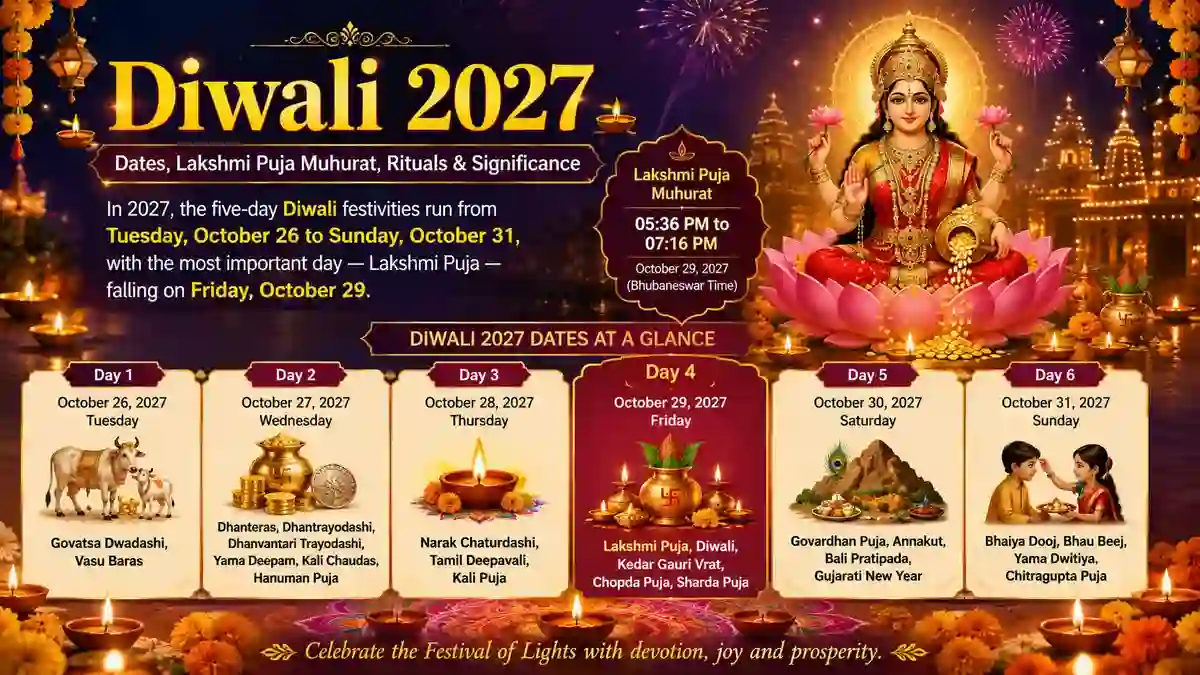
In 2027, the five-day Diwali festivities run from Tuesday, October 26 to Sunday, October 31, with the most important day Lakshmi Puja falling on Friday, October 29. This guide covers the complete day-by-day calendar, the exact Lakshmi Puja muhurat for Bhubaneswar, the meaning behind each ritual, and everything you need to celebrate with confidence and joy.
What is Diwali?
Diwali, also known as Deepavali, is the most significant religious festival among Hindus and is celebrated as the festival of lights. Spiritually, it signifies the victory of light over darkness, knowledge over ignorance, good over evil, and hope over despair. In most places, Diwali is celebrated over five days, each with its own name, meaning, and set of rituals.
Diwali 2027 Dates at a Glance
Here’s the complete five-day (technically six-day, with Maharashtra’s earlier start) Diwali calendar for 2027:
| Day | Date | Weekday | Occasion |
|---|---|---|---|
| Day 1 | October 26, 2027 | Tuesday | Govatsa Dwadashi, Vasu Baras |
| Day 2 | October 27, 2027 | Wednesday | Dhanteras, Dhantrayodashi, Dhanvantari Trayodashi, Yama Deepam, Kali Chaudas, Hanuman Puja |
| Day 3 | October 28, 2027 | Thursday | Narak Chaturdashi, Tamil Deepavali, Kali Puja |
| Day 4 | October 29, 2027 | Friday | Lakshmi Puja, Diwali, Kedar Gauri Vrat, Chopda Puja, Sharda Puja |
| Day 5 | October 30, 2027 | Saturday | Govardhan Puja, Annakut, Bali Pratipada, Gujarati New Year |
| Day 6 | October 31, 2027 | Sunday | Bhaiya Dooj, Bhau Beej, Yama Dwitiya, Chitragupta Puja |
Note that in Maharashtra, Diwali festivities begin a day earlier on Govatsa Dwadashi, while in Gujarat, they begin two days earlier on Agyaras and continue until Labh Panchami. So depending on where you are, your personal Diwali calendar might stretch a little longer.
Day-by-Day: How Diwali 2027 Unfolds
Day 1 – Govatsa Dwadashi (October 26, 2027, Tuesday)
Also known as Vasu Baras, this day marks the unofficial beginning of Diwali in many households, particularly in Maharashtra and Gujarat. It’s traditionally dedicated to the worship of cows and calves, honoring their role in sustaining rural life.
Day 2 – Dhanteras (October 27, 2027, Wednesday)
Dhanteras, short for Dhantrayodashi, is one of the most eagerly awaited days of the festival — this is when families traditionally buy gold, silver, or new utensils, believing it invites prosperity into the home for the year ahead. The day is also observed as Dhanvantari Trayodashi, honoring the god of medicine and health, and as Yama Deepam, when a lamp is lit in the evening to ward off untimely death. In some regions, this day is also celebrated as Kali Chaudas and includes Hanuman Puja.
Day 3 – Narak Chaturdashi (October 28, 2027, Thursday)
Known as Choti Diwali in many parts of North India, this day commemorates Lord Krishna’s victory over the demon Narakasura. Traditionally, people take a ritual oil bath early in the morning (Abhyang Snan) to cleanse themselves symbolically before the main celebrations. In Tamil Nadu, this day is actually the primary celebration and is known as Tamil Deepavali. In West Bengal, this same day is observed as Kali Puja, dedicated to Goddess Kali rather than Goddess Lakshmi.
Day 4 – Lakshmi Puja / Diwali (October 29, 2027, Friday)
This is the heart of the festival — the day most people mean when they simply say “Diwali.” Falling on Amavasya (the new moon night), this is when Goddess Lakshmi, along with Lord Ganesha and Goddess Saraswati, is worshipped for wealth, wisdom and new beginnings. Business communities also perform Chopda Puja, inaugurating new account books for the financial year ahead.
Day 5 – Govardhan Puja (October 30, 2027, Saturday)
This day celebrates Lord Krishna’s lifting of the Govardhan Hill to protect villagers from torrential rains sent by an angry Indra. It’s marked by Annakut, an offering of a large variety of food items to the deity. This day is also celebrated as Bali Pratipada, honoring the generous demon king Bali, and as the Gujarati New Year in Gujarati households.
Day 6 – Bhaiya Dooj (October 31, 2027, Sunday)
The festival closes on a note of sibling love with Bhaiya Dooj (also called Bhau Beej), when sisters pray for their brothers’ long life and wellbeing, and brothers, in turn, promise to protect them. This day is also observed as Yama Dwitiya and Chitragupta Puja.
Lakshmi Puja 2027: The Most Important Muhurat
If there’s one timing to circle on your calendar, it’s this one. Lakshmi Puja should ideally be performed during Pradosh Kaal — the period just after sunset — when the Amavasya Tithi is prevailing and, ideally, when a Sthir (fixed) Lagna is active. Tradition holds that performing the puja during a fixed lagna means Goddess Lakshmi will “stay” in your home rather than simply visiting and moving on.
Lakshmi Puja on Friday, October 29, 2027, in Bhubaneswar:
Lakshmi Puja Muhurat: 06:14 PM to 07:05 PM Duration: 52 minutes
Pradosh Kaal: 05:14 PM to 07:44 PM Vrishabha Kaal (Sthir Lagna): 06:14 PM to 08:13 PM
Amavasya Tithi begins: 08:47 PM on October 28, 2027 Amavasya Tithi ends: 07:05 PM on October 29, 2027
The 52-minute window given above is where Pradosh Kaal and Vrishabha (Sthir) Lagna overlap while Amavasya Tithi is still prevailing — making it the most auspicious combination available this year for common households to perform Lakshmi Puja.
What About Mahanishita Kaal?
Some traditions also recommend Mahanishita Kaal (late night) as an alternative time for Lakshmi Puja, particularly for Tantrik practitioners and pandits with specialized knowledge of this practice. For 2027, this window falls from 11:05 PM to 11:56 PM, with Simha Kaal running from 12:40 AM to 02:49 AM on October 30. For most families, however, the evening Pradosh Kaal Muhurat remains the recommended and most practical choice.
A Note on Choghadiya Timings
You may also come across Choghadiya Muhurat suggestions for Lakshmi Puja — for 2027, these fall in the morning (05:47 AM to 10:04 AM) and afternoon (11:30 AM to 12:56 PM, and 03:48 PM to 05:14 PM). It’s worth knowing that Choghadiya timings are traditionally considered suitable for travel, not for Lakshmi Puja itself — the Pradosh Kaal Muhurat remains the preferred choice for worship.
The Origin and Significance of Diwali
Diwali’s roots trace back to the era of Lord Rama, and some traditions place its origins even earlier, to the legendary churning of the milky ocean (Samudra Manthan), when Goddess Lakshmi emerged as a divine boon for the gods and all of humanity.
Given that Hinduism’s history spans thousands of years, it’s no surprise that numerous legends surround Diwali across different regions. Yet nearly all of them circle back to the same central themes: light triumphing over darkness, knowledge over ignorance, good over evil, and hope over despair.
Who is Worshipped During Diwali?
While Goddess Lakshmi, Lord Ganesha, and Lord Kuber are the most prominent deities associated with Diwali, the festival’s five days honor a much wider divine cast, including Lord Yamraj, God Dhanvantari, God Hanuman, Goddess Kali, Goddess Saraswati, Lord Krishna, and even the generous Demon King Bali.
Diwali Rituals and Traditions
Across India, families observe a beautiful mix of rituals during Diwali, including:
- Cleaning and decorating homes, often with new whitewash or fresh paint
- Buying new clothes, jewelry, and household items
- Preparing traditional homemade sweets
- Worshipping Goddess Lakshmi, Lord Ganesha and other deities
- Lighting diyas and decorating homes with strings of lights
- Bursting firecrackers (within local time restrictions)
- Trying traditional remedies believed to attract wealth
- Visiting relatives and family friends
- Distributing sweets, dry fruits, and gifts
- Calling distant family members to exchange Diwali wishes
For business communities, Diwali carries added significance: ink bottles (Davat) and pens (Lekhani) are sanctified through the worship of Goddess Maha Kali, while new account books, known as Bahi-Khate, are blessed under the worship of Goddess Saraswati as part of Chopda Puja.
How Diwali Celebrations Vary Across India
Diwali’s flavor changes noticeably as you travel across the country. Celebrations tend to be the most extravagant in North India, with cities like Delhi, Hyderabad, and Mumbai known for spectacular nighttime fireworks. In South India, much like Holi, Diwali is celebrated with comparatively less spectacle.
Celebrations are more moderate in Chennai and Kolkata — though for different reasons. In Chennai, Tamil Nadu, it’s Narak Chaturdashi rather than Lakshmi Puja that takes center stage. In Kolkata, West Bengal, devotees worship Goddess Kali instead of Goddess Lakshmi on the main day of the festival.
Diwali and Public Life
Despite being a major festival, most public services continue to function as usual during Diwali — restaurants, metro trains, buses, taxis, cinema halls, and emergency hospital services all remain operational. However, a significant portion of staff at commercial establishments typically take leave.
Interestingly, since many businessmen perform Chopda Puja and Lakshmi Puja on Diwali itself, a good number of shops and private offices actually stay open. Indian stock exchanges, though officially closed for the holiday, open for a symbolic one-hour window in the evening for Muhurat trading — a ritual considered auspicious among traders and observed for decades.
For businesses large and small, Diwali functions much like Christmas does in Western countries — it’s the peak sales season of the year, and many major film releases are timed to coincide with the festival.
Diwali is marked as a gazetted holiday, meaning government offices, schools, and colleges remain closed.
In recent years, many metro cities have imposed time limits on fireworks — typically 10 PM or 11 PM — to help curb noise pollution and allow for a peaceful night’s rest.
Diwali in Other Religions
While Diwali is fundamentally a Hindu festival rooted in the era of Lord Rama, it holds meaning in other faiths too. Sikhs celebrate this day as Bandi Chhor Divas, commemorating the release of Guru Hargobind Ji from imprisonment. Jains observe it as a day to commemorate Lord Mahavir, marking the anniversary of his attainment of moksha (liberation).
Frequently Asked Questions About Diwali 2027
The main Diwali festivities run from Tuesday, October 26 to Sunday, October 31, 2027, with the principal day of worship — Lakshmi Puja — falling on Friday, October 29, 2027.
The recommended Lakshmi Puja Muhurat is 06:14 PM to 07:05 PM on October 29, 2027, in Bhubaneswar, based on the overlap of Pradosh Kaal and Vrishabha (Sthir) Lagna.
Dhanteras falls on Wednesday, October 27, 2027.
Narak Chaturdashi falls on Thursday, October 28, 2027.
Govardhan Puja falls on Saturday, October 30, 2027.
Bhaiya Dooj falls on Sunday, October 31, 2027, marking the final day of the five-day Diwali festivities.
Pradosh Kaal, the period right after sunset, is when Amavasya Tithi is believed to align best with a Sthir (fixed) Lagna. Performing Lakshmi Puja during this time is believed to ensure the Goddess’s blessings remain in the home rather than being fleeting.
No — while the core themes remain the same, celebrations vary by region. Chennai emphasizes Narak Chaturdashi, Kolkata worships Goddess Kali instead of Lakshmi, and Maharashtra and Gujarat both begin their festivities earlier than most other states.