There’s a particular feeling in the air as Devi Paksha approaches, the sound of dhaak drums being tuned, the smell of fresh paint on half-finished pandal walls, and that quiet, electric anticipation that only Durga Puja brings. For millions of people across West Bengal, Odisha, Assam, Tripura and Manipur, this isn’t just a festival, it’s the emotional heart of the entire year.
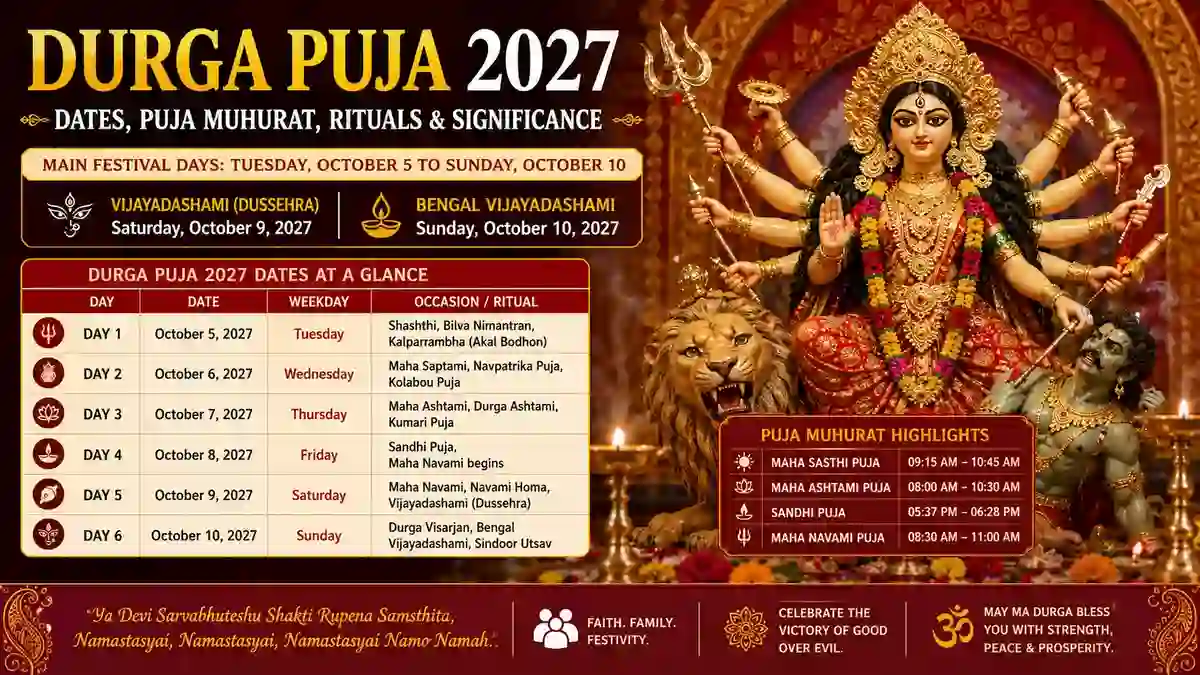
In 2027, the main days of Durga Puja run from Tuesday, October 5 to Sunday, October 10, with Vijayadashami (Dussehra) falling on Saturday, October 9, and Bengal Vijayadashami observed a day later, on Sunday, October 10. This guide walks you through every important date, the exact puja timings, the story behind the festival, and the rituals that make Durga Puja one of the most beloved celebrations in the world.
What is Durga Puja?
Durga Puja is an annual Hindu festival dedicated to Goddess Durga, celebrated during Devi Paksha — a 15-day period in the Hindu month of Ashwin. The name Devi Paksha literally means “Fortnight of the Goddess.” This period begins the day after Sarvapitru Amavasya and ends on Kojagori Lokkhi Puja.
While the festival is celebrated across several eastern and northeastern Indian states, it holds special significance in West Bengal, where it is not just a religious observance but the single biggest cultural event of the year — a time when families reunite, cities transform with elaborate pandals, and entire communities come together in celebration. Durga Puja is also known as Durgotsava or Sharadotsava.
In many other Indian states, this same fortnight is observed as Navratri. Though both are dedicated to Goddess Durga and fall during the same period, the rituals and customs differ quite a bit between the two traditions.
Durga Puja 2027 Dates at a Glance
Here’s a simple breakdown of the main days of Durga Puja 2027, along with the specific rituals observed on each:
| Day | Date | Weekday | Occasion |
|---|---|---|---|
| Day 1 | October 5, 2027 | Tuesday | Shashthi, Bilva Nimantran, Kalparambha (Akal Bodhon) |
| Day 2 | October 6, 2027 | Wednesday | Maha Saptami, Navpatrika Puja, Kolabou Puja |
| Day 3 | October 7, 2027 | Thursday | Maha Ashtami, Durga Ashtami, Kumari Puja |
| Day 4 | October 8, 2027 | Friday | Sandhi Puja, Maha Navami begins |
| Day 5 | October 9, 2027 | Saturday | Maha Navami, Navami Homa, Vijayadashami |
| Day 6 | October 10, 2027 | Sunday | Durga Visarjan, Bengal Vijayadashami, Sindoor Utsav |
As you can see, Vijayadashami is observed on two different days depending on region and tradition — the broader Vijayadashami/Dussehra falls on October 9, while in West Bengal, the Bengali community observes it a day later on October 10, alongside Durga Visarjan.
Day-by-Day: How Durga Puja 2027 Unfolds
Day 1 – Shashthi (October 5, 2027, Tuesday)
The festivities officially begin with Shashthi, the sixth day of Devi Paksha. This day includes Bilva Nimantran, an invitation extended to the Goddess through the sacred Bilva (bael) tree, and Kalparambha, also known as Akal Bodhon — the untimely invocation of the Goddess. The Bengali term for the day translates as Ashshin 18, 1434 in the Bengali calendar.
According to legend, Akal Bodhon carries deep meaning. Traditionally, Chaitra Navratri in spring was considered the appropriate time to worship Goddess Durga. However, before his battle with Ravana, Lord Rama needed her blessings urgently and could not wait for the traditional season. He performed a Chandi Homa and invoked the Goddess out of season — hence “Akal Bodhon,” meaning “untimely awakening.” Because Rama went on to defeat Ravana after receiving her blessings, this autumn invocation became firmly established as the primary time to worship Durga.
Day 2 – Maha Saptami (October 6, 2027, Wednesday)
The second day is marked by Navpatrika Puja and Kolabou Puja. The Navpatrika, or “nine leaves,” is a symbolic representation combining nine different plants, ceremonially bathed and dressed like a bride — often referred to affectionately as “Kolabou.” This ritual represents the Goddess’s power manifesting through nature itself.
Day 3 – Maha Ashtami / Durga Ashtami (October 7, 2027, Thursday)
One of the most significant days of the festival, Maha Ashtami includes the beautiful and deeply symbolic Kumari Puja, where a young girl is worshipped as a living embodiment of the Goddess — a reminder that divinity resides in purity and innocence, not just in idols.
Day 4 – Sandhi Puja (October 8, 2027, Friday)
This day marks the meeting point between Ashtami and Navami tithis, known as Sandhi Puja — considered one of the most powerful and auspicious moments of the entire festival. It is during this brief window that Goddess Durga is believed to have taken the form of Chamunda to defeat the demons Chanda and Munda. Traditionally, 108 earthen lamps are lit during this ritual, creating one of the most visually stunning moments of the celebration.
Day 5 – Maha Navami (October 9, 2027, Saturday)
Maha Navami brings the Navami Homa, a sacred fire ritual marking the final day of active worship before the Goddess’s departure. This is also the day Vijayadashami is observed in most parts of India outside Bengal.
Vijayadashami Vijay Muhurat: 01:32 PM to 02:19 PM Duration: 47 minutes
Day 6 – Vijayadashami / Durga Visarjan (October 10, 2027, Sunday)
The festival reaches its emotional peak on this final day. In West Bengal, this is when Bengal Vijayadashami is observed, along with Durga Visarjan — the tearful, joyous immersion of the Goddess’s idol into a river or water body, symbolizing her return to Mount Kailash.
Bengal Vijayadashami Aparahna Puja Time: 12:45 PM to 03:06 PM Duration: 2 hours 22 minutes
The day also includes Sindoor Utsav, where married women smear each other with vermilion (sindoor) as a gesture of blessing, love, and celebration — one of the most joyous and photographed traditions of the entire festival.
Important Tithi and Nakshatra Timings for 2027
For those who like to track the precise astrological timings:
- Dashami Tithi begins: 09:01 AM on October 9, 2027
- Dashami Tithi ends: 11:40 AM on October 10, 2027
- Shravana Nakshatra begins: 10:17 AM on October 9, 2027
- Shravana Nakshatra ends: 01:25 PM on October 10, 2027
These timings, calculated for Bhubaneswar, help explain why Vijayadashami is observed on different days in different traditions — the Dashami Tithi spans across both October 9 and October 10.
Why is Durga Puja Celebrated?
At its core, Durga Puja celebrates the victory of good over evil. According to the Devi Mahatmya, one of the most important Hindu scriptures dedicated to the Goddess, Durga Puja marks the day Goddess Durga defeated the fearsome buffalo demon Mahishasura, who had terrorized the heavens and could not be defeated by any god. Durga was created from the combined divine energy of all the gods specifically to vanquish him — and her triumph is what the entire festival commemorates.
Simultaneously, on the same fortnight, Hindus across India celebrate Vijayadashami or Dussehra, marking Lord Rama’s victory over the ten-headed demon king Ravana. In Nepal, this same celebration is observed as Dashain.
Together, these two stories reinforce the same timeless message: righteousness ultimately triumphs over darkness.
Who is Worshipped During Durga Puja?
While Goddess Durga is the central deity, the festival honors an entire divine family. Durga Puja also includes worship of Lord Shiva, her consort, since Durga is considered an aspect of Goddess Parvati herself.
According to Bengali tradition, when Durga descends to Earth during this fortnight, she arrives with her four children:
- Goddess Lakshmi — goddess of wealth and abundance
- Goddess Saraswati — goddess of knowledge and the arts
- Lord Ganesha — remover of obstacles
- Lord Kartikeya — god of courage and warfare
This is why elaborate Durga Puja pandals almost always feature all five deities together in a single magnificent tableau, each seated around the central figure of Durga slaying Mahishasura.
Key Rituals of Durga Puja
Durga Puja is rich with rituals, many of which have been passed down for generations. Some of the most important include:
- Chandi Patha — the recitation or listening of sacred verses glorifying the Goddess, traditionally beginning from Mahalaya
- Pandal viewing — elaborately decorated structures housing artistic depictions of Goddess Durga, which draw crowds from across cities and even countries
- Morning Pushpanjali — floral offerings made to the Goddess during the first four days of the celebration
- Shodashopachar Durga Puja — a detailed sixteen-step worship ritual performed from Saptami through Navami
- Dhunuchi Dance — a mesmerizing dance performed with burning incense pots (dhunuchi) in front of the Goddess, accompanied by the beat of the dhaak drum
- Chandi Homa — a sacred fire ritual performed on Maha Navami
- 108 earthen lamps — lit during Sandhi Puja, symbolizing light overcoming darkness
- Durga Visarjan — the ceremonial immersion of the idol on Vijayadashami
- Sindoor Utsav — married women applying vermilion to one another in celebration
- Exchange of Vijaya greetings — a warm tradition of seeking blessings from elders and reconciling with loved ones
Durga Puja Beyond West Bengal
While West Bengal, Assam and Tripura celebrate the full ritualistic Durga Puja across six days, other Indian states observe the same fortnight as Navratri, with a different set of customs — including fasting, garba and dandiya dances, and Ram Leela performances leading up to Dussehra. In these regions, the term “Durga Puja” is used far less often in everyday conversation, and when it is used, it typically refers specifically to the Bengali style of celebration.
In Odisha, Durga Puja holds a particularly special place, blending Bengali-style pandal traditions with local Odia customs, making cities like Bhubaneswar wonderfully vibrant during this period.
Frequently Asked Questions About Durga Puja 2027
The main days of Durga Puja 2027 run from Tuesday, October 5 (Shashthi) to Sunday, October 10 (Durga Visarjan).
Vijayadashami falls on Saturday, October 9, 2027, with the Vijay Muhurat from 01:32 PM to 02:19 PM. In West Bengal, Bengal Vijayadashami is observed a day later, on Sunday, October 10, 2027.
Maha Ashtami, including Kumari Puja, falls on Thursday, October 7, 2027.
Sandhi Puja, marking the junction of Ashtami and Navami, falls on Friday, October 8, 2027.
Durga Visarjan takes place on Sunday, October 10, 2027, alongside Bengal Vijayadashami and Sindoor Utsav.
Because the Dashami Tithi spans both October 9 and October 10 in 2027, different regional traditions observe Vijayadashami on the day that aligns best with their specific ritual timing — most of India on October 9, and West Bengal on October 10.
Durga Puja celebrates Goddess Durga’s victory over the demon Mahishasura, symbolizing the triumph of good over evil, and coincides with the Rama-Ravana victory story celebrated as Dussehra.